
Play Chicken Dash Now!
Home → Demo
Chicken Dash Demo
What the Chicken Dash demo gives you
The TaDa Gaming title Chicken Dash operates as a crash game with a theoretical return of 96.85%, which establishes a house edge of 3.15% over extended play sessions. This percentage reflects the long-term statistical expectation rather than short-term results, meaning players should anticipate variance across individual rounds. The high volatility setting indicates that wins may be less frequent but potentially larger in magnitude compared to low volatility alternatives.
Players can access three selectable risk levels, including Easy, Normal, and Hard modes, which influence the probability of the chicken being hit by vehicles during its crossing attempt. Each successful hop raises the multiplier, allowing for potential payouts up to a maximum win of 20,659x the stake. The Bonus Bag feature adds an extra layer of reward mechanics that activates randomly during gameplay, offering additional value beyond standard multipliers.
In contrast, titles like Fortune Gems 2 by the same studio operate on a different mechanic with a lower RTP of 94.38% and low volatility. While Fortune Gems 2 features reels and paylines, Chicken Dash relies entirely on tap-to-advance mechanics without traditional slot elements. This distinction highlights how Crash games offer distinct risk-reward profiles compared to conventional reel-based casino games available at many online platforms.
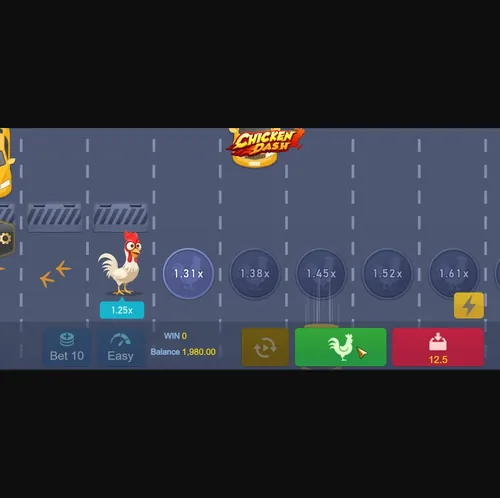
Starting the demo without registration
Accessing the demo version of Chicken Dash requires no account creation or personal data submission, allowing immediate interaction with the TaDa Gaming interface. Players can initiate rounds instantly, observing how the multiplier rises with each successful tap before deciding whether to cash out. This frictionless entry point supports thorough testing of the game's mechanics without any financial commitment or regulatory verification steps.
The absence of registration barriers ensures that users can evaluate the high volatility nature of the game across multiple attempts within a single session. Since there are no spins or reels involved, the focus remains strictly on timing the cash-out action against the rising multiplier curve. This straightforward approach helps players understand the core loop without distraction from complex bonus structures or wagering requirements typical in other products.
Comparatively, real-money play often demands KYC verification and deposit limits, whereas the demo environment remains entirely unrestricted for educational purposes. The maximum multiplier potential of x20,659 is visible in theory, though actual outcomes depend heavily on player decision-making speed. Understanding these dynamics helps users prepare for the psychological pressure present when transitioning to funded accounts where stakes are real.
The operator-configurable RTP variations, such as 97% or 95.50% cited by some aggregators, do not apply to the standard demo configuration used for general review. These discrepancies arise from different casino implementations rather than inherent game design changes, meaning the demo provides a consistent baseline for analysis. Users should verify specific site settings if they intend to replicate exact conditions during live play later.
Demo balance and bet sizes
The demo mode typically provides a virtual credit balance sufficient for testing the full range of betting options available in the TaDa Gaming product. While specific starting amounts vary by platform, players can adjust stakes to observe how different bet sizes impact potential returns relative to the 96.85% RTP. This flexibility allows for strategic experimentation without risking actual funds, helping users identify comfortable wagering levels before committing real money.
Betting ranges in similar instant games often span from minimal entry points to higher limits, enabling both casual players and high rollers to participate. In Chicken Dash, the absence of fixed paylines means every tap directly influences the multiplier growth rate, making bet size a key variable in risk management. Players can test how quickly their virtual balance depletes under aggressive tapping strategies versus conservative cash-out approaches across various risk settings.
For context, competitors like Fortune Gems 2 offer fixed bet structures aligned with their 3x3 reel grid, contrasting sharply with the dynamic stake adjustments possible here. The ability to modify bets freely enhances the educational value of the demo, allowing users to calculate expected losses based on the 3.15% house edge. This transparency supports informed decision-making regarding bankroll allocation when moving to paid versions of crash-style games.
What carries over to real money
Game mechanics and risk level selections remain identical between demo and real-money modes, ensuring that skills developed during practice translate directly to live play. The TaDa Gaming engine processes outcomes using the same algorithmic logic, meaning the 96.85% RTP and 3.15% house edge apply equally regardless of currency type. Players who master timing their cash-outs in the demo will face the same mathematical realities when wagering actual deposits.
The maximum win cap of 20,659x applies uniformly across all modes, providing a consistent upper limit for potential payouts regardless of stake size. However, real-money play introduces additional constraints such as withdrawal limits, transaction fees, and bonus terms that do not exist in the free version. Understanding these operational differences is crucial for managing expectations regarding profit retention and overall gaming costs over time.
Unlike slots with spinning reels, this crash format offers immediate feedback on decisions, making it easier to track performance metrics in real-time. The lack of spin delays means more rounds can be completed per hour, accelerating the realization of the theoretical return percentage. This efficiency allows players to gather meaningful data on their strategy effectiveness much faster than in traditional reel-based casino products.
Browser requirements for the demo
Modern web browsers support the HTML5 technology powering the TaDa Gaming interface, ensuring smooth performance on desktop and mobile devices alike. The tap-to-advance mechanic relies on responsive touch inputs, requiring compatible screens that accurately register user gestures without latency. Stable internet connectivity is essential to maintain real-time multiplier updates and prevent disconnections during critical cash-out moments.
System resources such as RAM and processing power have minimal impact on gameplay stability, as the graphical demands are relatively lightweight compared to high-end slots. The absence of complex animations or large asset files means the game loads quickly even on older hardware configurations. This accessibility ensures that a broad audience can engage with the content without needing specialized gaming equipment or software upgrades.
Comparatively, titles with intricate visual effects may require stronger GPUs, whereas Chicken Dash focuses on functional clarity over aesthetic complexity. The consistent rendering across platforms guarantees that the risk levels and Bonus Bag triggers appear identically on all supported devices. This uniformity prevents technical disparities from influencing gameplay outcomes, maintaining fairness and predictability for all users accessing the demo.
Chicken Dash: key facts
| Parameter | Value |
|---|---|
| Game | Chicken Dash |
| Studio | TaDa Gaming |
| RTP | 96.85% |
| House edge | 3.15% |
| Volatility | high |
| Max win | 20,659x |
Reading the paytable in demo mode
The theoretical return to player for Chicken Dash stands at 96.85%, a figure published by developer TaDa Gaming that defines the long-term house edge of 3.15% over hundreds of thousands of rounds. This percentage indicates that players can expect to retain nearly ninety-seven cents of every euro wagered when playing this crash mechanic across extended sessions rather than isolated attempts. The high volatility rating suggests that these returns are distributed through infrequent but substantial multiplier events, requiring patience during dry spells. Some aggregators incorrectly list alternative RTP configurations such as 97% or 95.50%, which may cause confusion regarding the actual payout structure offered by specific operators.
Testing bet levels safely
The maximum win cap for Chicken Dash is set at 20,659x the initial stake, a limit established by TaDa Gaming that applies to the highest multiplier achievable during a single round. Players utilizing the easy risk level will encounter lower frequency crashes compared to the hard setting, directly influencing how quickly this maximum win potential can be realized through consistent cashing out. A wager of one cent could theoretically yield a payout exceeding two hundred euros if the chicken survives all traffic lanes without being hit by a vehicle. This ceiling remains constant regardless of the operator's bonus terms, ensuring that the game mechanics do not artificially inflate or suppress the top prize available to the user.
How many rounds make a fair test
A fair statistical assessment of Chicken Dash requires observing thousands of rounds because the 96.85% RTP only stabilizes over a very long run as defined by TaDa Gaming. Each tap-to-advance action represents one independent trial where the player must decide whether to cash out before the multiplier crashes, making short sessions prone to significant deviation from the theoretical average. Comparing this crash format to Tower Rush, which offers a fixed max win of 100x with an RTP of 97.00%, highlights the different risk profiles inherent in instant games. The high volatility of Chicken Dash means that a small sample size often fails to reflect the true expected value due to the unpredictable nature of the traffic hazards.
Session length and pacing
The pacing of Chicken Dash is determined by the player's tapping speed, allowing each round to last only seconds or extend significantly as the multiplier climbs toward the 20,659x maximum. This rapid cycle enables users to complete hundreds of trials in the time it takes to play a traditional slot, facilitating quicker testing of the three selectable risk levels: easy, normal, and hard. The inclusion of Bonus Bags adds variable elements to the session flow, occasionally awarding extra multipliers that disrupt the standard cash-out rhythm and potentially shorten the overall time required to reach significant wins. Unlike static reel-based games, the immediate feedback loop keeps the engagement level consistently high throughout the entire gaming period.
Common mistakes in free play
A frequent error in demo mode is ignoring the 96.85% RTP figure provided by TaDa Gaming, leading players to believe that winning streaks are sustainable strategies rather than random variance within a high volatility environment. Many users fail to utilize the cash-out feature early enough, risking their accumulated multiplier against the inevitable crash that ends every round eventually, regardless of the chosen risk level. Comparing this behavior to the structured progression of Tower Rush, with its capped 100x max win, reveals how uncontrolled greed in crash games leads to faster bankroll depletion in real money play. The absence of reels and paylines means there are no fixed patterns to exploit, making disciplined cashing out the only reliable method for preserving funds.
Demo versus real money differences
The theoretical return to player (RTP) for Chicken Dash is 96.85%, representing the long-term expected payout ratio across millions of rounds. Some aggregators list alternative configurations of 97% or 95.50%, indicating that the operator can adjust this parameter, which directly impacts the house edge of 3.15%. This variance means that actual session results will fluctuate significantly more in demo mode than in cash play where the specific configured RTP applies.
Chicken Road by InOut Games offers a contrasting model with an RTP of 98.00% and a maximum win cap of x3,608,855, highlighting the vast difference in potential payout structures between instant games. The maximum multiplier in Chicken Dash stands at x20,659, allowing for substantial wins despite the high volatility inherent in its tap-to-advance crash mechanic. Players must weigh these extreme multipliers against the lower base RTP found in some casino implementations compared to other titles.
The distinction between demo and real money modes lies in the financial risk taken during each round where the chicken crosses lanes of traffic. In demo play, users can experiment with the three selectable risk levels without risking capital, whereas real money sessions involve genuine stakes up to the operator limits. Understanding the mechanics of cashing out before a vehicle hits the chicken is crucial for managing bankroll effectively in both environments.
Why results vary between sessions
High volatility in Chicken Dash ensures that winning rounds are less frequent but potentially larger, with the maximum multiplier reaching x20,659 times the stake. This statistical profile contrasts sharply with low volatility games that offer smaller, more consistent payouts, making session length a critical factor in determining overall profitability. Players should expect extended periods of losses interspersed with rare, high-multiplier events when engaging with this specific game variant.
The RTP of 96.85% serves as a long-term average over hundreds of thousands of spins, never guaranteeing a specific return for any single session or hour of play. Operators may configure the game with different RTP values like 95.50% or 97%, causing significant discrepancies in expected returns between different casino platforms. These configuration differences explain why two players using identical strategies might experience vastly different outcomes based on the underlying mathematical model applied.
Comparing Chicken Dash to Chicken Road reveals how varying max wins and RTPs influence session variance, with the latter offering a higher RTP of 98.00% and a massive x3,608,855 cap. The crash mechanic in Chicken Dash requires precise timing to cash out before the multiplier ends, adding a skill element that does not exist in purely random slot machines. This interaction between chance and timing contributes to the unpredictable nature of individual gaming sessions.
Using demo to learn the bonus round
The Bonus Bag feature in Chicken Dash provides additional rewards alongside the main tap-to-advance mechanic, requiring players to understand when to secure profits before a crash occurs. Demo mode allows users to practice identifying optimal cash-out points without financial consequence, helping them familiarize themselves with the visual cues of increasing multipliers. Mastering this timing is essential for maximizing returns in the high-volatility environment where the house edge sits at 3.15% based on the 96.85% RTP.
Unlike traditional slots, Chicken Dash lacks reels and paylines, instead relying on a rising multiplier that the player must cash out from before termination by a vehicle. The demo version enables exploration of the Easy, Normal, and Hard risk levels, each affecting the frequency of crashes and potential multiplier growth. This trial phase helps players determine which risk setting aligns best with their tolerance for variance before committing real funds to the game.
Analyzing the performance of different strategies in demo mode against the backdrop of the x20,659 maximum multiplier highlights the importance of disciplined cash-out decisions. While Chicken Road offers a different gameplay loop with its own RTP of 98.00%, understanding the unique crash dynamics of Chicken Dash remains vital for success. Practicing in demo mode builds the reflexes needed to handle the rapid pace of the game without the pressure of losing real money.
DemoRTP & VolatilityHow to PlayAuto CashoutStrategyBonusesMobileDownload & AppMax WinSimilar GamesReviewFAQSitemap
Chicken Dash 2026